AlomWare Toolbox
Automation
Create plain-English actions that launch apps, type text and phrases, position and size your daily windows, remember what you need, and respond to PC events. There's no complicated coding, so it's perfect for everyone.

AlomWare Toolbox. Version 9.0.0.5 for 64-bit versions of Windows 7, 8, 10 and 11. Primarily English text. AlomWare Toolbox provides powerful system automation, window management, clipboard history, text expansion, PC states, scheduled tasks and reminders, and more in one single tiny portable exe file! No installation needed, no account, no AI, no tracking you, and no telemetry. Always 100% safe as verified by independent third parties.
Back in the DOS days, smart people used Borland Sidekick to boost their productivity. Sidekick was a suite of handy tools that popped up from a hotkey to let you do something without leaving your current work.
AlomWare Toolbox is the modern-day alternative to Borland Sidekick. It's not exactly the same, but as with Sidekick you just press a hotkey and up pops a window over your current work with practical PC tweaks and useful tools to assist your workday. The app is free (with limits; see the FAQ) so why not give it a try? Then join the ranks of our satisfied paid users by making the one-time investment in your productivity today!
Create plain-English actions that launch apps, type text and phrases, position and size your daily windows, remember what you need, and respond to PC events. There's no complicated coding, so it's perfect for everyone.
Type a short trigger text and AlomWare Toolbox can auto-expand it to type your email address, canned responses, logins, and other text. Hotkeys can be used to type dynamic text, like the date.

Keep a history of copied text and images so it's available again when needed. Convert clipboard text to other formats or clean it up. There are privacy options to exclude specific text and apps.

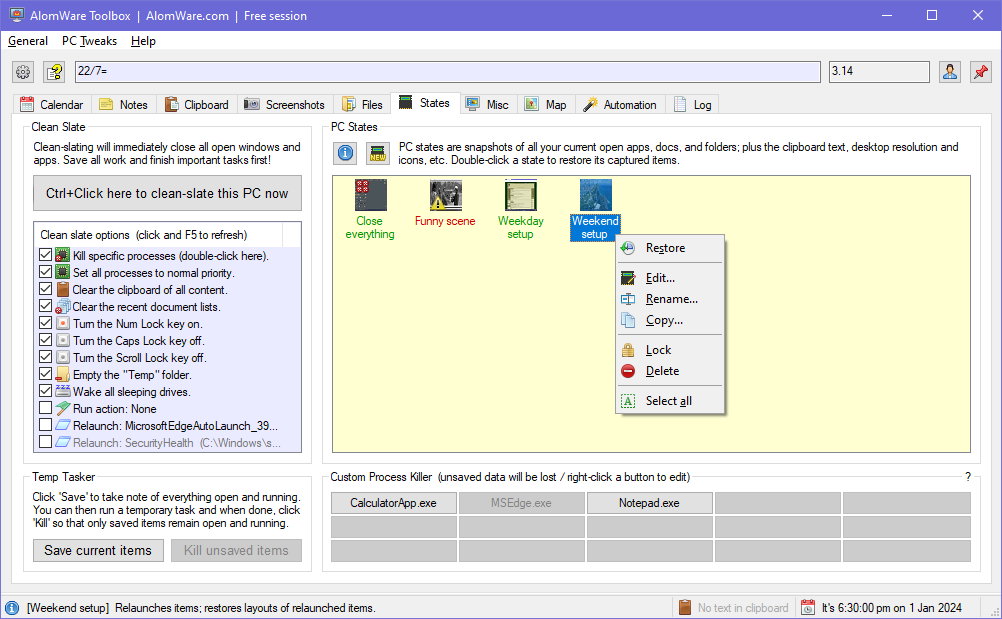
Save the way your current apps and windows are arranged (and optionally the desktop size and its icons, the sound volume, clipboard text, etc) and restore that environment later.
Watch video.
Use the "Calendar" tab to browse dates, create reminders and scheduled tasks, see countdowns, and do date calculations. All so much easier than using the Windows "Task Scheduler".

Make windows auto-open the way you set them, create zones, keep windows on top, roll them up to their title bar, dock them together, dim them, freeze the focus to prevent stealing, and more.

Work overview: See a real-time live thumbnail
overview
of your open windows.
Item map: See a
map
of where you've been so you can access those items later.
Caps Lock indicator:
See the Caps Lock state
at all times (perfect for laptops!).
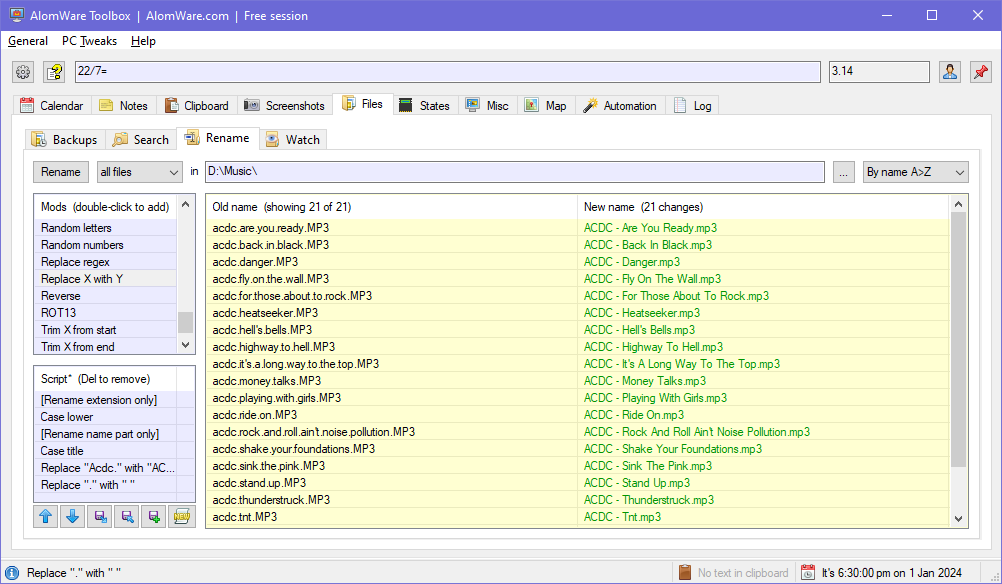
Bulk file renaming:
Rename multiple files
quickly and easily with scripts for re-use.
File versioning:
Files (up to 512 MB) can auto-backup when opened with the app.
Admin window detection: See which apps were
run as admin
for easy identification.
Color picker and OCR text capture:
Pick colors and copy text
directly from your desktop.
Lock PC but keep desktop visible: Lock your PC while still being able to
see the desktop.
Typewriter sounds:
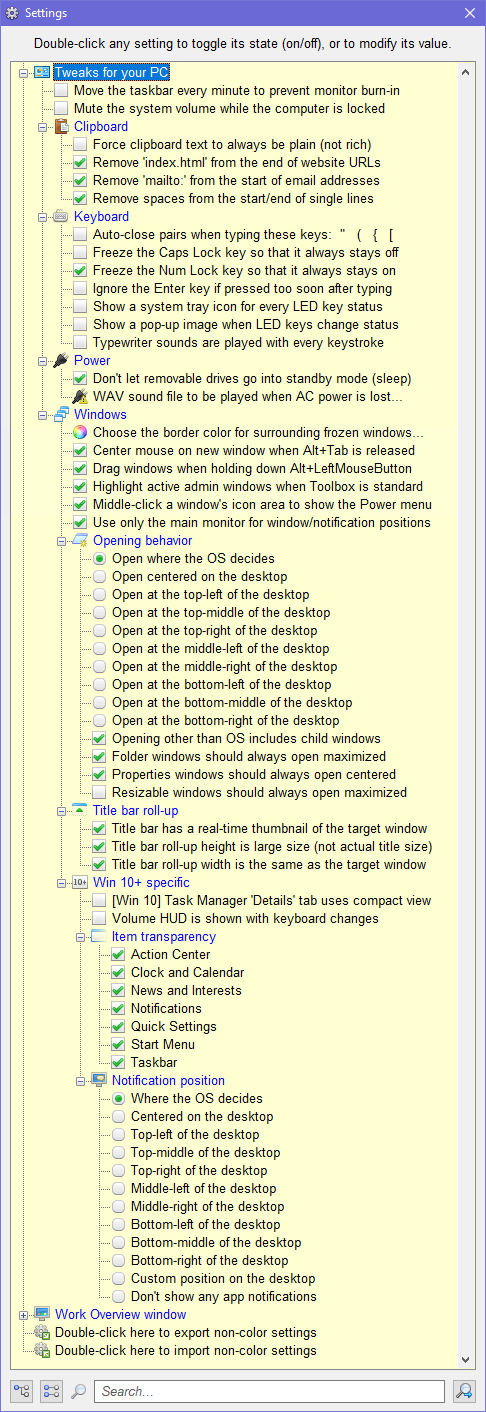
Hear mechanical typewriter sounds while typing
for feedback accuracy.
OLED protection: Auto-move the taskbar in its own space to
prevent OLED monitor burn-in.
Classic Control Panel: Quickly access the old Windows
Control Panel
items from within the app.
And more again!
See
Features and
PC tweaks,
or see our forum's
Solutions
and
Tips and Tricks.
AlomWare Toolbox gives you hundreds of quality-of-life improvements to your daily PC use. Here's some quick examples:
That's just the tip of the iceberg! With AlomWare Toolbox's automation functions, you can create your own custom actions to make your daily PC work more efficient.
AlomWare Toolbox requires a 64-bit version of Windows 7, 8, 10, or 11; but please note that some features will only work with Windows 10 or later (these are clearly mentioned in the app). Admin rights are optional, but allow more control of your PC if the app is run that way. English is the only supported lanugage as the app uses an insane amount of in-app text, but the app's main window elements do support other languages by copying and editing the "Toolbox Languages > English.ini" file. There are both English and Spanish INI files ready for use when the app first runs.
AlomWare Toolbox is a true standalone portable exe file (yep, not files) so it doesn't actually need installation (the way all good apps should be!). To start using it, unzip its folder somewhere on your PC (or to a USB stick) and double-click the "Toolbox.exe" file inside the folder to start it. Watch our video if you need help.
Since AlomWare Toolbox is a portable app, just quit it from its "General" menu and then delete its folder. That's it! But why not send us feedback so we can improve and maybe make it better? We love constructive criticism, so please don't hold back.
AutoHotkey is a full text-based programming language and is not easy for most people to use. There is also the risk that using AutoHotkey can get you banned from games you play online, so why risk your gaming purchases by using AutoHotkey? AlomWare Toolbox is a lightweight scripting tool (not a programming language) and therefore won't get you banned when using it for online gaming.
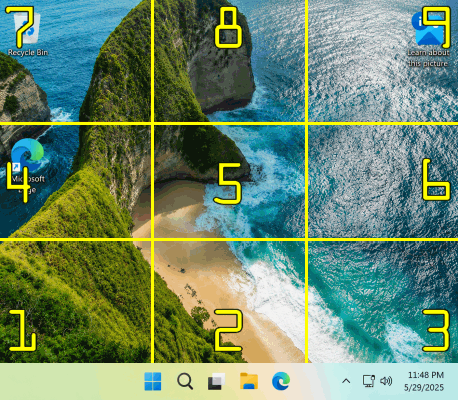
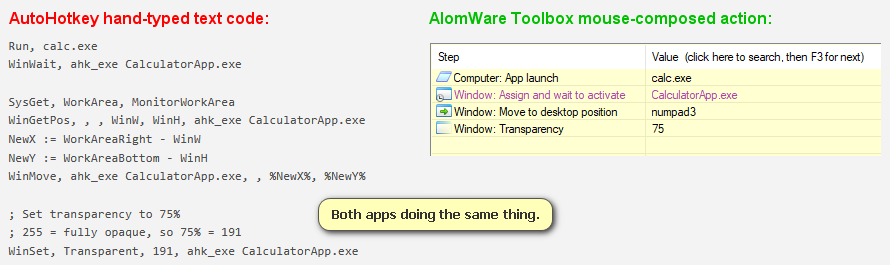
Let's do a quick comparison of using AutoHotkey vs AlomWare Toolbox, with each doing the same function to see their differences. In the image below, we see both apps are launching the Windows Calculator, moving it to the bottom-right of the desktop ("numpad3" shown for AlomWare Toolbox), and setting its transparency level to 75%. As you can see, AlomWare Toolbox is far more simple to understand and use, with no need to type everything by hand or use a confusing non-friendly value of "191" to specify 75% for the transparency level. With AlomWare Toolbox, you directly specify the percentage you need without having to engage in silly mathematics.
When comparing Microsoft PowerToys vs AlomWare Toolbox, you have to remember that PowerToys is a very limited small set of PC tweaks and functions to enhance your PC, and PowerToys is not customizable like AlomWare Toolbox. You literally can only use PowerToys for what it offers built-in, as it has no scripting functionality of its own. AlomWare Toolbox wins here because it can be expanded with new features by using its automated actions, essentially making it future-proof.
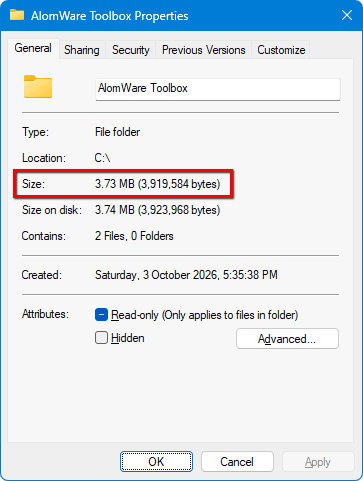
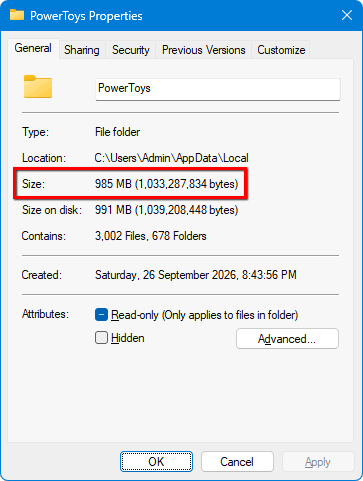
The other two major differences between PowerToys and AlomWare Toolbox is that PowerToys needs to be installed on the target PC (which requires administrator rights to do so) and the initial installed folder size is a whopping 985 MB (almost 1 GB!) with 1003 files littered all over your PC. In contrast, AlomWare Toolbox doesn't need any installation because it's a single portable exe file, with its initial folder size under 4 MB. AlomWare Toolbox stores all its data in one single folder alone, unlike the file scattering of PowerToys (which is not good for a healthy PC). AlomWare Toolbox respects your computer and doesn't waste your hard drive space and mess your PC's file system by dumping files everywhere.
Lastly, anything you meticulously set up with PowerToys is for use on that specific PC alone and can't be used on any others; whereas AlomWare Toolbox can be stored and run from a USB stick so you can use your custom automated actions, auto-typing, clipboard history, and window arrangements (plus more) on any PC that you use.
| Feature | AlomWare Toolbox | Microsoft PowerToys |
|---|---|---|
| Windows 7 and 8 support (64-bit PCs only) | ✓ Most app features | ✗ Windows 10 and 11 only |
| Initial disk space required for the app's first-time use | ✓ 4 MB (2 files) | ✗ 985 MB (3002 files!) |
| Can be run from a USB stick on any PC without installation | ✓ | ✗ |
| App is stored in one single folder to maintain PC cleanliness | ✓ | ✗ |
| Auto-typing and text expansion from shortcut text or hotkeys | ✓ | ✗ |
| Automated actions available from hotkeys or other triggers | ✓ | ✗ |
| Technical support directly from the development team | ✓ Paid users only | ✗ You're on your own |
| Calendar, date calculations, reminders and scheduled tasks | ✓ | ✗ |
| Clipboard history for text and images with unlimited items | ✓ | ✗ |
| Window zones, position, focus freezing, title bar roll-up, etc | ✓ Many window tweaks | ✗ FancyZones only |
Most of your existing AlomWare Toolbox settings and data are unaffected with each update to the app. The only things that may change are some action steps if they get updated with a bug fix or enhancement. These are clearly marked in the Change Log as "Change", "Removed" or "Renamed"; and your actions may need manual editing if they've been affected. Note that there is never any obligation to update the app, and you can decline an update or disable update checks altogether.
Free use of the app is limited to one hour per app launch, but you can relaunch it after that to get another hour of free use, and so on indefinitely. There is no technical support for free users, but you can ask questions on our forum for help. Paying for an unlock code removes these limitations and provides technical support by way of direct emails with the actual development team (we don't use "tickets" or have support monkeys following a script).
Yes, and yes. This is not a subscription. AlomWare Toolbox is portable software, so the unlock code you get will work on any PC (it's not hardware-locked). Please use it only on PCs that you personally own and don't share the code. Sharing can be detected and the code revoked if sharing is discovered.


The price below is for individual use only (contact us for other uses). Casual use is always free with a one-hour session limit per app launch, but you can relaunch indefinitely. For paid users, an internet connection is required at app launch (but not during use) for license validation.
Paid for an unlock code? Please allow up to 24 hours for it to arrive (usually much sooner) at your PayPal email address.
Have another question, feedback, or need help with AlomWare Toolbox? You can email us below or visit our new forum.
AlomWare Toolbox has no malware or spyware (see VirusTotal for proof) and has also been certified "100% Clean" by Softpedia. You can read positive reviews on Trustpilot from satisfied customers. We wouldn't be around since 2022 if we were untrustworthy.
As the app can auto-type things for you, remember the clipboard, move and size your windows, etc; you should whitelist the unzipped folder (not the "Toolbox.exe" file) in your anti-virus app to prevent it quarantining/blocking the app.
AlomWare Toolbox is regularly updated, meaning that you might get this warning about an unknown app being started. Click "More info" and then "Run anyway" to acknowledge the warning and allow the app to run. You'll only be shown this warning once.
While you are browsing our website, no personal or identifiable information is collected about you, and we have no way of knowing who you are. Some non-personal information will be collected about your visit, such as the browser you're using, the links you clicked, your operating system, desktop resolution, etc. This is normal practice for websites worldwide.
App Data: The data you create with our apps is kept locally on the PC on which it's run, and nothing on your PC is ever copied off or transmitted over the internet to anyone (unless you explicitly allow it, such as saving your app data to the cloud or sending someone an email with it).
Personal Data: This is only used for the purpose for which it was provided. For example, we may use your email address to respond to any queries from you, or to announce news of an update or bug-fixes for any purchases you have made from us. Your email address and other personal information will never be shared with third parties under any circumstances (unless specifically required by law, subpoena, or court order).